The Drone | AI & Technology News | November 12, 2026

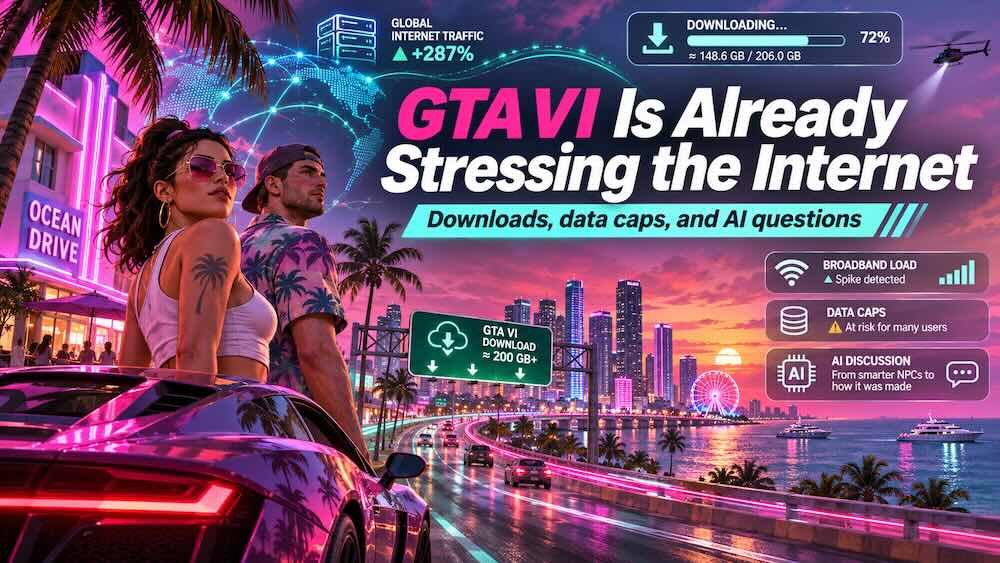
Grand Theft Auto VI hasn’t even launched, and it’s already causing problems for the internet.
After thirteen years of waiting, millions of gamers are preparing to return to Vice City on November 19. But before anyone can steal a car, outrun the police, or discover what Rockstar has hidden in its sprawling fictional version of Florida, they have to download the damn thing.
And it’s enormous.
With PlayStation 5 players needing at least 212 gigabytes of storage, GTA VI is becoming an extraordinary test of the infrastructure that delivers our digital lives. Broadband providers are reporting record traffic, Comcast is temporarily boosting customers’ internet speeds, and network engineers are preparing for what could be one of the biggest entertainment launches in history.
Meanwhile, the game’s publisher has made an unusually strong statement about artificial intelligence: the massive open world of GTA VI wasn’t built with generative AI.
For an industry convinced that AI will eventually create entire virtual universes, that’s an interesting development.
GTA VI Has Already Broken Broadband Records
The downloading began on November 10, nine days before the game’s official release. Within hours, internet providers were watching their traffic graphs climb into unfamiliar territory.
British telecommunications company Virgin Media O2 reported that November 10 became the busiest day in its broadband network’s history. During the first hour of preloading, traffic jumped 51.6% compared with the same hour the previous Tuesday. By 9 a.m., the company reported approximately 73.3% more downloaded data than during the equivalent period the week before.
Those were not the only records.
Peak broadband traffic exceeded the company’s previous record by 3.8%, while total daily data volume surpassed its previous high by 4%. Remarkably, the earlier daily record had been set just days before by a Fortnite update.
Over in Germany, internet provider 1&1 reported traffic to PlayStation Network and Xbox Live running at approximately ten times its normal level during the opening night of preloads.
To be clear, that doesn’t mean the entire German internet experienced a tenfold increase. The figure refers specifically to traffic involving the two gaming networks. Similarly, Virgin Media’s figures describe its own network rather than global internet usage.
But these are real measurements, not predictions. One unreleased video game has already pushed parts of the internet beyond their previous records.
And the official launch is still a week away.
Sources: Virgin Media O2 | German traffic reporting

How Much Data Does One Video Game Actually Consume?
Sony recommends clearing at least 212 gigabytes of space for GTA VI on PlayStation 5. Downloads vary by platform, with Virgin Media referencing a roughly 190GB version in its own speed calculations.
Put those numbers into perspective.
If one million players each download 212GB, that’s approximately 212 petabytes of transferred data. Ten million equivalent downloads would represent roughly 2.12 exabytes.
Those are illustrative calculations, not confirmed global download totals. But they demonstrate how quickly an individual game becomes an infrastructure event when millions of households participate.
And that traffic doesn’t exist in isolation. People are still watching Netflix, attending video meetings, backing up their phones, using AI assistants, and streaming NFL games. The internet doesn’t get to take the afternoon off because everyone wants to visit Vice City.
Content delivery networks can distribute downloads across regional servers, while early preloading spreads demand over several days instead of concentrating everything on release night. Those systems help prevent a single giant bottleneck, but they don’t eliminate the need to move extraordinary quantities of data.
This also explains why different internet providers may experience very different results. A network with ample regional capacity might handle the launch without difficulty. Another could see temporary congestion around gaming downloads.
The important distinction is that GTA VI has already set network-specific records. There is not yet a verified figure showing how much total worldwide internet traffic has increased because of the game.
Xfinity Is Offering Free Speed Boosts. But What About Data Caps?
Comcast has decided to turn GTA VI into a marketing opportunity.
On November 9, the company announced that eligible Xfinity Internet customers could claim a free 15-day speed boost, increasing download speeds to as much as 2 gigabits per second.
Comcast estimates that customers with sufficiently fast connections could download GTA VI in as little as 30 minutes. That’s considerably more appealing than leaving a console running overnight.
Customers can activate the offer through the Xfinity app or the Membership section of its website. The promotion is advertised as available for redemption through December 3, although customers should check their account for specific eligibility and terms.
But here’s the important detail: the promotion increases speed, not monthly data allowances.
Xfinity’s current internet plans include unlimited data, so most customers on newer plans don’t need an extra allowance anyway. However, customers on certain older plans may still have a 1.2-terabyte monthly cap.
For those legacy customers, downloading a game this large can consume a substantial portion of their monthly allowance. Xfinity says excess usage on capped plans can result in charges of $10 per additional 50GB, up to $100 monthly, after an applicable courtesy month.
There is no announced GTA VI-specific increase to those legacy data caps.
It’s an interesting contrast. Internet companies have spent years selling customers faster and faster connections. Now an entertainment launch is giving them a chance to demonstrate exactly what those speeds are good for.
Apparently, the answer is downloading 212 gigabytes of fictional criminal activity before breakfast.
Sources: Comcast’s GTA VI promotion | Xfinity data caps
So How Much Artificial Intelligence Is Actually in GTA VI?
This is where the story becomes particularly interesting.
Take-Two Interactive, the parent company of Rockstar Games, has been enthusiastic about artificial intelligence. CEO Strauss Zelnick has repeatedly discussed the industry’s use of AI and machine learning, including generative tools that can improve efficiency.
But in February, Zelnick told GamesIndustry.biz that generative AI had “zero part” in what Rockstar was building for GTA VI.
He emphasized that Rockstar’s enormous virtual worlds are handcrafted, with individual streets, neighborhoods, buildings, and environments carefully constructed by developers rather than generated automatically.
That doesn’t mean GTA VI is completely devoid of artificial intelligence.
Video games have used traditional AI techniques for decades. Systems governing non-player characters, navigation, traffic, combat behavior, and responses to player actions are commonly described as game AI. They generally involve rules, decision-making systems, pathfinding, and other computational techniques rather than large language models generating content on demand.
Rockstar has not publicly provided enough technical detail to establish precisely which AI methods power GTA VI’s individual NPCs.
Despite online speculation, there’s also no verified announcement that pedestrians will use ChatGPT-like conversations, that police officers will improvise dialogue with generative models, or that missions will be dynamically created by an AI chatbot.
There is, however, a confirmed AI application connected to the game’s graphics.
Rockstar says GTA VI uses PlayStation Spectral Super Resolution, or PSSR, on PlayStation 5 Pro. Sony describes PSSR as AI-powered upscaling that analyzes rendered images and reconstructs additional visual detail.
That’s artificial intelligence serving the graphics pipeline, not generating the game’s characters, story, or locations.
The distinction matters. AI can improve how an existing virtual world appears on a screen without being responsible for creating that world.
And for a project that has consumed years of development and an enormous creative workforce, Rockstar’s emphasis on human craftsmanship is a notable counterpoint to the industry’s increasingly aggressive AI marketing.
Sources: Take-Two’s comments on generative AI | Rockstar’s technical announcement | Sony’s explanation of PSSR

The Next Internet Test: Cloud Gaming
Downloading GTA VI is only part of the infrastructure story.
Microsoft announced that GTA VI will also be available through Xbox Cloud Gaming on November 19, including access for Xbox One owners who cannot run the game natively on their older hardware.
Cloud gaming changes the equation.
Instead of downloading hundreds of gigabytes and running the game locally, Microsoft’s servers run the software and stream the resulting video to the player’s console. Controller inputs travel back to the remote server.
This eliminates the massive initial local installation for cloud players, but creates an ongoing need for bandwidth, processing power, and low-latency network connections.
Traditional online games generally exchange relatively small amounts of information about player movement, position, and actions. Cloud gaming must also continuously deliver video and audio.
That makes latency particularly important. A short delay during a television stream is usually irrelevant. A short delay when someone is driving at 140 miles per hour through Vice City can end with an extremely expensive fictional insurance claim.
Microsoft says GTA VI cloud streaming begins at 1 a.m. Eastern on November 19 in supported markets, with eligibility and purchasing requirements depending on the service.
The larger lesson is that gaming traffic will not necessarily disappear once the initial downloads finish. Cloud streaming can produce continuing demand, while future patches and updates may trigger additional download spikes.
This makes GTA VI both a one-time bandwidth event and a useful demonstration of how cloud-based entertainment is changing internet infrastructure.
Source: Xbox’s GTA VI cloud gaming announcement
Cybercriminals Have Already Arrived in Vice City
Unfortunately, gamers aren’t the only people excited about the launch.
Cybersecurity company Netcraft recently investigated websites exploiting GTA VI anticipation through fake download offers, supposed early access, bogus mobile editions, and promises of free copies.
Some attempted to trick visitors into making payments or completing surveys. Others directed users toward potentially malicious downloads.
Malwarebytes previously identified fake GTA VI promotional sites distributing information-stealing malware disguised as a game installer.
It’s a predictable consequence of an enormous entertainment launch. Millions of people are searching for download instructions, release information, screenshots, and early access. Criminals exploit that demand by creating convincing-looking websites and fraudulent advertisements.
AI-generated promotional images and impersonation tools add another potential complication to the broader online fraud environment, although the documented GTA VI cases do not establish that every fraudulent site used generative AI.
For players, the advice is straightforward: use Rockstar, PlayStation, or Xbox’s official services. There is no legitimate secret PC installer or free mobile version hiding behind a suspicious advertisement.
The real game is already expensive enough. There’s no reason to throw in a complimentary identity theft.
Sources: Netcraft investigation | Malwarebytes research
Elsewhere in AI: Google and Anthropic Raise the Stakes
While GTA VI dominates gaming headlines, the artificial intelligence industry is having a remarkable week of its own.
Google Unleashes Gemini 4 Carbon
On November 10, Google expanded access to Gemini 4 Carbon, its latest high-end AI model designed for complex reasoning, cybersecurity, software engineering, and scientific research.
Google is positioning Carbon for demanding tasks that require extended planning and verification rather than ordinary chatbot conversations.
The company is also previewing a feature called /swarm in Google Antigravity, allowing developers to coordinate multiple AI agents working on different aspects of a project.
The interesting development isn’t simply another model claiming better benchmark scores. It’s the continued movement toward AI systems that can coordinate substantial projects rather than respond to isolated prompts.
Google is offering introductory API pricing of $2 per million input tokens and $10 per million output tokens, although more complex models can consume additional tokens to solve a task.
The true measure will be how reliably these systems complete useful work, not merely how impressive their benchmark scores appear in a launch presentation.
Source: Google’s announcement
Anthropic Launches New Models and Heads Toward Wall Street
Anthropic introduced Claude Fable 5.2 and Claude Mythos 5.2 on November 9, emphasizing improvements in coding, scientific reasoning, engineering, and complex technical research.
The company claims that coordinated AI agents were able to formally verify a proof of Fermat’s Last Theorem in approximately 30 hours. That’s a notable demonstration of automated mathematical reasoning, although the experiment involved a specialized multi-agent setup rather than a typical consumer chatbot.
Anthropic is also preparing for an enormous initial public offering.
On November 10, the company announced an IPO roadshow involving 825 million shares, with an expected offering price between $70 and $78 per share.
At the top of that range, the offering would represent approximately $64.4 billion in gross share sales, although not all proceeds would go to Anthropic because some shares are being sold by existing stockholders.
The IPO will become a major test of investor confidence in the AI economy.
Wall Street has spent years pouring money into the technology. Now investors are getting another opportunity to decide how much they believe that future is worth.
Sources: Claude Fable and Mythos 5.2 | Anthropic IPO announcement
AI Data Centers Are Considering an Enormous Amount of Natural Gas
A new BloombergNEF analysis illustrates the increasingly uncomfortable relationship between AI development and the environment.
Researchers identified approximately 181 gigawatts of proposed on-site gas-fired electricity generation associated with data center projects, with more than 90% of that capacity located in the United States.
Many developers are considering their own natural gas generation because existing electrical grids cannot connect new facilities quickly enough.
The study suggests that if all the proposed American projects were constructed and operated under its modeled assumptions, they could produce approximately 345 million metric tons of carbon dioxide equivalent annually.
There is an important qualification: these are announced or proposed projects, not power plants already operating. The total is not a forecast that all 181 gigawatts will actually be built.
Nevertheless, the scale is striking.
For years, technology companies have advertised increasingly ambitious clean-energy commitments. Now the race to secure enough electricity for artificial intelligence is encouraging some developers to consider substantial investments in fossil-fuel infrastructure.
Some companies describe these arrangements as temporary. But once expensive gas equipment is installed, the financial incentive to continue using it may last considerably longer than originally promised.
The consequences extend beyond the technology industry. Communities face questions about air quality, greenhouse gas emissions, water consumption, electrical infrastructure, and who ultimately pays for these projects.
AI’s energy problem is no longer merely a question of how much electricity a chatbot consumes. It is becoming a question of what kinds of power plants companies are willing to build to keep the industry expanding.
Sources: BloombergNEF analysis | The Guardian’s November 11 reporting
New York Moves Toward Stronger AI Oversight
New York opened registration for large frontier AI developers on November 10 as it prepares to implement the state’s RAISE Act.
The law requires covered developers to meet safety and transparency requirements, including publishing safety frameworks and reporting serious safety incidents within 72 hours.
Large frontier developers must register by January 1, 2027.
Governor Kathy Hochul also announced a research center based at Binghamton University that will help evaluate advanced AI systems and their safety practices.
The move reflects a growing divide between the speed at which AI companies want to develop more capable systems and the pace at which governments believe they can safely be deployed.
Source: New York State announcement
The Drone’s Take: Two Very Different Visions of Technology
There’s something particularly revealing about the collision between Grand Theft Auto VI and the artificial intelligence industry this week.
On one side, we have a video game that required years of careful design, an enormous development effort, and a level of craftsmanship its publisher insists couldn’t simply be produced by generative AI.
On the other, we have technology companies investing extraordinary sums into systems intended to automate increasingly complex work, while struggling to obtain enough electricity and computing infrastructure to operate them.
Both industries are pushing the boundaries of what computers can accomplish. Both depend on enormous amounts of digital infrastructure. But they offer very different ideas about what technological progress should look like.
GTA VI’s immediate impact is also wonderfully measurable. We don’t need a complicated AI benchmark to evaluate it. A game has pushed broadband networks beyond previous records before anyone has even started playing.
And unlike a great deal of today’s AI marketing, we can already see some of the results.
The coming launch will test whether internet providers can handle one of the most concentrated bursts of entertainment demand ever recorded. It will also show how effectively cloud gaming can deliver a massive new release without requiring every player to own the latest hardware.
As for artificial intelligence, GTA VI offers a useful reminder that more technology doesn’t automatically mean better entertainment. Powerful tools can assist the people building a world without becoming a substitute for the imagination that makes it worth visiting.
In a week when AI companies are raising billions and proposing new power plants to feed their computing ambitions, one of the world’s most anticipated digital products is preparing to launch with a distinctly different message.
Sometimes the most impressive thing a computer can do is help humans build something extraordinary.
And sometimes, apparently, that extraordinary thing is a 212-gigabyte playground where you can steal a police car and drive it into the ocean.
Welcome back to Vice City.
Leave a Reply